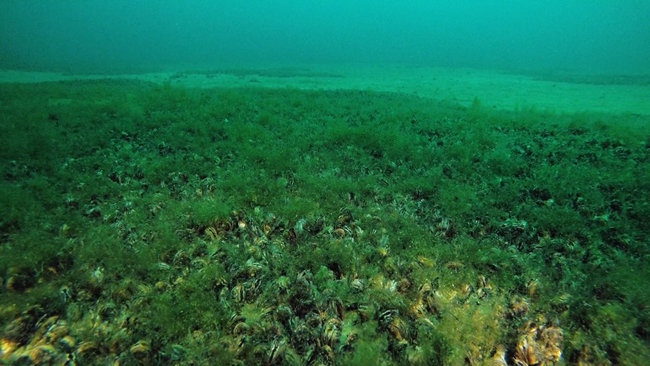
Quagga mussels found in the Great Lakes. Credit: Alexander Karatayev and Lyubov Burlakova, Great Lakes Center, Buffalo State University
— By Chris Gonzales, Freelance Writer, New York Sea Grant
Contact:
Lane Smith, Research Program Coordinator, NYSG, E: lane.smith@stonybrook.edu, P: (631) 632-9780
Scientists recently published an 80-page review of all of the known natural enemies of zebra and quagga mussels
Buffalo, NY, May 13, 2024 - Zebra and quagga mussels, collectively known as dreissenids, are bivalves that cause serious harm to aquatic ecosystems and industries.
These mussels block the intake pipes of water treatment plants, slash the feet of recreational swimmers, consume algae and plankton that would otherwise feed native fish and mussels, and create conditions ripe for blooms of harmful algae.
In an 80-page paper co-funded by the New York Sea Grant and the Hudson River Foundation, authors over 600 international references on the natural enemies of Dreissena species, including the 252 publications cited by the first edition of the paper1 covering nearly 170 years of research. Authored by Alexander Karatayev, Daniel Molloy, and Lyubov Burlakova of SUNY Buffalo State University, the paper discusses the biology and ecology of organisms known to be involved in the predation (143 species), parasitism and commensalism (86 species and higher taxa), and competitive exclusion (14 species) of species in the genus Dreissena.
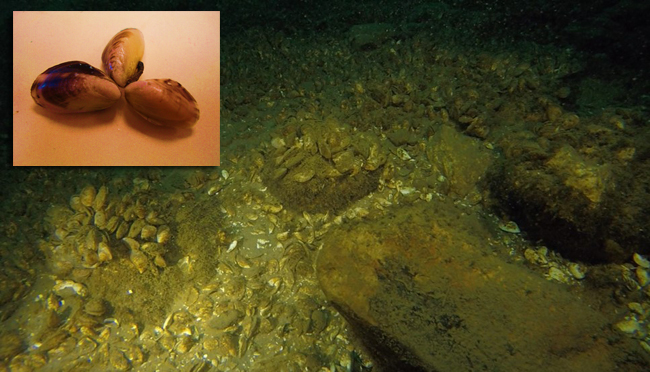
Quagga mussels found in the Great Lakes. Credit: Alexander Karatayev and Lyubov Burlakova, Great Lakes Center, Buffalo State University
“We found that while predators can at times have major impacts on dreissenid populations, these reductions are typically only temporal and in shallow or otherwise restricted areas within large waterbodies,” Burlakova said. “A cumulative effect of a growing suite of enemies may have a constant, but overall limited, role in suppressing Dreissena densities, one far from any likelihood of population eradication.”
The article was published in Reviews in Fisheries Science & Aquaculture.2
References
1 Molloy, Daniel & Karatayev, Alexander & Burlakova, Lyubov & Kurandina, Dina & Laruelle, Franck. (1997). Natural enemies of Zebra Mussels: predators, parasites, and ecological competitors. Reviews in Fisheries Science. 5(1) 27-29. 10.1080/10641269709388593
2 Karatayev, A. Y., Molloy, D. P. & Burlakova, L. E. 2024. Natural Enemies of zebra and quagga mussels: Predators, parasites, and ecological competitors. Reviews in Fisheries Science & Aquaculture 32:1-80 DOI: 10.1080/23308249.2023.2235437
More Info: New York Sea Grant
Established in 1966, the National Oceanic and Atmospheric Administration (NOAA)’s National Sea Grant College Program promotes the informed stewardship of coastal resources in 34 joint federal/state university-based programs in every U.S. coastal state (marine and Great Lakes) and Puerto Rico. The Sea Grant model has also inspired similar projects in the Pacific region, Korea and Indonesia.
Since 1971, New York Sea Grant (NYSG) has represented a statewide network of integrated research, education and extension services promoting coastal community economic vitality, environmental sustainability and citizen awareness and understanding about the State’s marine and Great Lakes resources.
NYSG historically leverages on average a 3 to 6-fold return on each invested federal dollar, annually. We benefit from this, as these resources are invested in Sea Grant staff and their work in communities right here in New York.
Through NYSG’s efforts, the combined talents of university scientists and extension specialists help develop and transfer science-based information to many coastal user groups—businesses and industries, federal, state and local government decision-makers and agency managers, educators, the media and the interested public.
New York Sea Grant, one of the largest of the state Sea Grant programs, is a cooperative program of the State University of New York (SUNY) and Cornell University. The program maintains Great Lakes offices at Cornell University, SUNY Buffalo, Rochester Institute of Technology, SUNY Oswego, the Wayne County Cooperative Extension office in Newark, and in Watertown. In the State's marine waters, NYSG has offices at Stony Brook University and with Cornell Cooperative Extension of Nassau County on Long Island, in Queens, at Brooklyn College, with Cornell Cooperative Extension in NYC, in Bronx, with Cornell Cooperative Extension of Ulster County in Kingston, and with Cornell Cooperative Extension of Westchester County in Elmsford.
For updates on Sea Grant activities: www.nyseagrant.org, follow us on social media (Facebook, Twitter/X, Instagram, Bluesky, LinkedIn, and YouTube). NYSG offers a free e-list sign up via www.nyseagrant.org/nycoastlines for its flagship publication, NY Coastlines/Currents, which it publishes 2-3 times a year.