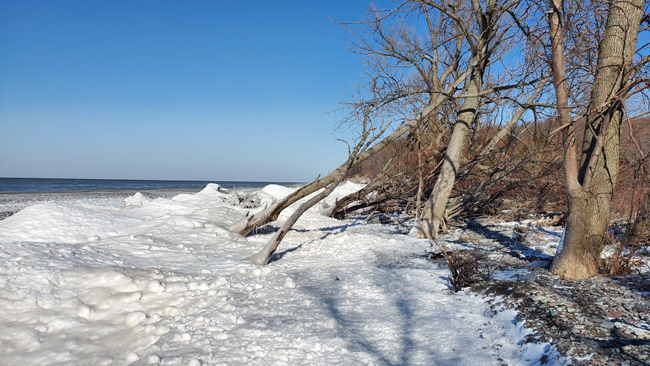
Ice shove on shorelines can damage trees during winter storm events as seen here in Cayuga County, New York. Credit: Roy Widrig/New York Sea Grant
Are Natural, Nature-Based or Hard Structures Needed to Remediate Erosion Along New York’s Great Lakes Shoreline?
Free Assistance from Sea Grant Helps Landowners Identify Options
Contacts:
Roy Widrig, New York Sea Grant Coastal Processes and Hazards Specialist, P: 315-234-1916, E: rlw294@cornell.edu
Kara Lynn Dunn, NYSG's Freelance Publicist, P: 315-465-7578, E: karalynn@gisco.net
Oswego, NY, February 24, 2026 — This winter’s extreme conditions along New York’s Great Lakes are amplifying the natural action of wind, water, ice, and storms that can cause significant shoreline erosion and economic damage to coastal business and personal properties, structures, and operations. New York Sea Grant is encouraging shoreline property owners to reach out now for free assistance in planning how to identify the best options for remediation and restoration from winter’s impact.
New York Sea Grant Coastal Processes and Hazards Specialist Roy Widrig has expertise with shoreline erosion management, flooding mitigation, living shorelines, and dune and natural habitat restoration. He works with individual property owners, municipalities, and community groups to address their location-specific shoreline erosion issues and options.
Widrig notes, “One-size-fits-all shoreline remediation approaches should be avoided as each property site has its own unique features, stressors, and resulting impact. New York Sea Grant provides both virtual and in-person assessments, considering each site place-by-place.”
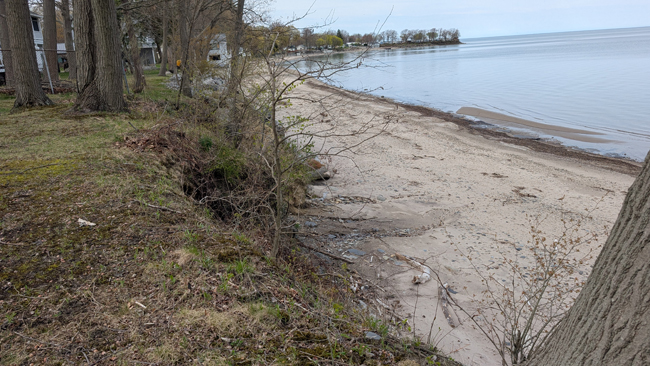
Shoreline erosion due to seiche impact on a Lake Erie shoreline in Erie County, New York (May, 2025). Credit: Roy Widrig/New York Sea Grant
Property owners can start now to document winter storm events and shoreline impact from storm surge and wave action, seiche events along Lake Erie, or lake effect snow, ice, and wind along Lake Ontario. Widrig initially uses photos and descriptions, uploaded by property owners to New York Sea Grant’s Virtual Visit portal at nyseagrant.org/glcoastal, to make a preliminary evaluation of damage. He then contacts property owners to discuss remediation options and, when warranted, schedules in-person site assessments.
When hard structures or construction may be needed to restore or protect a shoreline property, Widrig provides information on best practices; local, state, and federal regulations; and how to select a waterfront project contractor.
Widrig has assisted a wide range of projects in each of New York’s Great Lakes shoreline counties. Recent projects have included living shoreline installation, dune restoration, seawall repairs, and drainage improvements.
Widrig is the author of the "Working with Nature" guide (pdf) to matching plant species native to New York to specific shoreline restoration needs. He can be reached through New York Sea Grant’s Oswego office at 315-234-1916 or rlw294@cornell.edu.
New York Sea Grant provides this assistance with support from the New York State Environmental Protection Fund, in partnership with the New York State Department of Environmental Conservation’s Great Lakes Program.
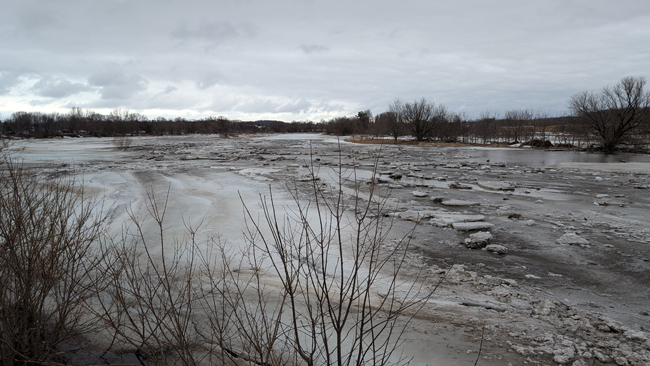
Ice jams in rivers and creeks can cause localized flooding during the spring freeze/thaw cycle, as here in Oswego County, New York, in March 2025. Credit: Roy Widrig/New York Sea Grant
More Info: New York Sea Grant
New York Sea Grant (NYSG) is a university-based, statewide Federal-State collaboration between the State University of New York (SUNY), Cornell University, and the National Oceanic and Atmospheric Administration (NOAA). It is one of 34 university-based programs that connects research, extension, and education with the needs of coastal communities, environments, and economies through NOAA.
Since 1971, NYSG has supported science-based solutions for a wide range of water-related challenges and opportunities across the state. Through NYSG’s efforts, university scientists and extension specialists help develop and transfer science and technical information to educational institutions, businesses, agencies, and industries; federal, state and local governments; the media; and the interested public. The program is administratively based at Stony Brook University (SBU) and Cornell's College of Agriculture and Life Sciences (CALS).
NYSG historically leverages on average a 5.5-fold return on each invested federal dollar, annually. The State benefits from this, as these resources are invested in Sea Grant staff and their work in communities right here in New York.
New York Sea Grant, one of the largest of the state Sea Grant programs, maintains Great Lakes offices at Cornell University, SUNY Buffalo, Rochester Institute of Technology, SUNY Oswego, the Wayne County Cooperative Extension office in Newark, and in Watertown. In the State's marine waters, NYSG has offices at Stony Brook University and with Cornell Cooperative Extension of Nassau County on Long Island, in Queens, at Brooklyn College, with Cornell Cooperative Extension in NYC, in Bronx, with Cornell Cooperative Extension of Ulster County in Kingston, and with Cornell Cooperative Extension of Westchester County in Elmsford.
Established in 1966, the National Oceanic and Atmospheric Administration (NOAA)’s National Sea Grant College Program promotes the informed stewardship of coastal resources in 34 joint federal/state university-based programs in every U.S. coastal state (marine and Great Lakes) and Puerto Rico. The Sea Grant model has also inspired similar projects in the Pacific region, Korea and Indonesia.
For updates on Sea Grant activities: www.nyseagrant.org, follow us on social media (Facebook, Twitter/X, Instagram, Bluesky, LinkedIn, and YouTube). NYSG offers a free e-list sign up via www.nyseagrant.org/nycoastlines for its flagship publication, NY Coastlines/Currents, which it publishes quarterly.