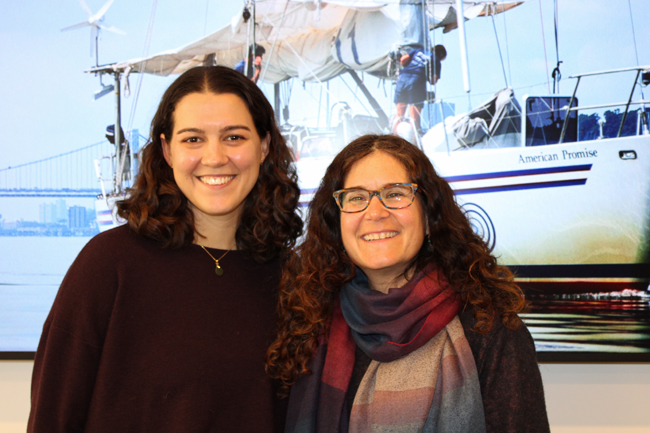
(L to R) Catherine Prunella (NYSG Water Quality Extension Specialist) and Rachael Zoe Miller (founder, the Rozalia Project) stand together for a picture. Credit: Sumayyah Uddin/NYSG.
Contact:
Catherine Prunella, NYSG Water Quality Extension Specialist, P: (718) 502-8092, E: cjp275@cornell.edu
Catherine Prunella (NYSG Water Quality Extension Specialist) and Rachael Zoe Miller (The Rozalia Project) presented a joint microfiber workshop to students, staff, and designers at the Fashion Institute of Technology
— By Sumayyah Uddin, NYSG's Science Writer
Manhattan, NY, April 8, 2026 — The Fashion Institute of Technology (FIT) held its 20th annual Sustainable Business and Design Conference on its Manhattan campus in early April. Hours before the conference fully kicked off with its slate of speakers from sustainable fashion brands, a number of pre-conference workshops offered the chance for students to engage more intimately with focus areas of interest — including a workshop highlighting how clothing sheds microplastics, commonly called “microfibers,” into New York waterways.
Led by Catherine Prunella (NYSG Water Quality Extension Specialist) and Rachael Zoe Miller (the Rozalia Project), the workshop — titled “Science and Solutions for a Clean Ocean” — educated budding gamechangers in the fashion industry on how clothing sheds microfibers. The workshop was especially significant to the audience of FIT students, people who would be making textile and fiber choices in the future depending on the careers they chose to pursue.
“The fibers that we're talking about in those samples are between five and a half and twenty-five microns. To put microns in perspective, the average human hair is seventy microns in diameter,” Miller explained, emphasizing just how microscopic the fibers being discussed are. “So we're talking about things smaller than the width of a human hair. Because microfibers are so small, smaller than a red blood cell, they are able to get through human tissues and what were thought of as protective barriers for foreign objects in the human body.”
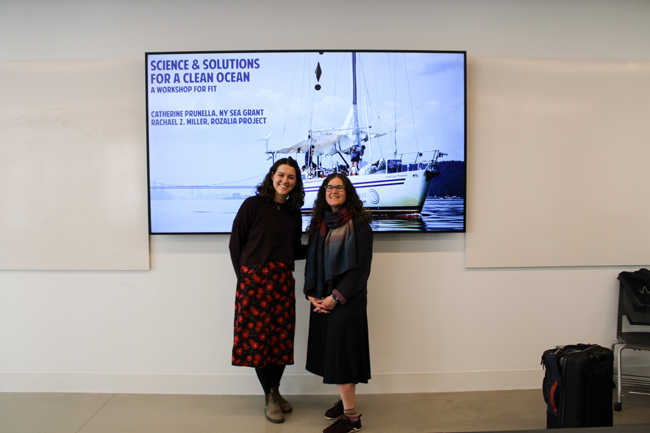
(L to R) (L to R) Catherine Prunella (NYSG Water Quality Extension Specialist) and Rachael Zoe Miller (founder, the Rozalia Project) stand together for a picture in front of the title slide of their presentation, “Science and Solutions for a Clean Ocean.” Credit: Sumayyah Uddin/NYSG.
Miller introduced students to the Rozalia Project’s mission, showcasing how the crew tracks microfiber spread through currents. Microfibers enter waterways when we launder clothing. Because clothing is often made with synthetic fibers (like polyester), and contains synthetic elements (like dyes and additives), some microfibers will never fully break down. Hotspots (or areas where large groups of microfibers are collected) can offer potential clues of the path that these plastics take through the ocean.
“Thinking about the textile industry as potentially one of the biggest producers of microplastic and microfiber pollution, we want to know how we're going to help reduce that,” explained Miller. “All of this data can help us understand if there are any geographical areas that we should be focusing on — say, geographical areas that are related to the textile industry.”
Meanwhile, Prunella talked to the audience about potential solutions for the microfiber problem — namely, NYSG partner Columbia University’s research on laundry filtration systems. These systems are designed to remove microfibers during the washing process so they can be disposed of afterwards, similar to a lint screen in a dryer.
“Water, when it leaves your washing machine, goes to a wastewater treatment facility if you're in New York City,” she explained. “That wastewater treatment facility will remove a bunch of those fibers, but some of them are so, so, so tiny that they're going to leak into the Hudson and East Rivers or the ocean, depending on where you live. So I'm working with partners that are developing a filter that goes inside the washing machine.”
Prunella also covered how some people are working to instead introduce microfiber filtration at the manufacturing level. While filtration devices might be a viable option for reducing waste, it also places a lot of pressure on individuals to change their behavior, which might be difficult.
“If you think about the lifespan of a garment, there are so many different steps where you could try to cut this pollutant off,” Prunella said. “You could go into manufacturing and put a filter right there, while the textile is actually being created.”
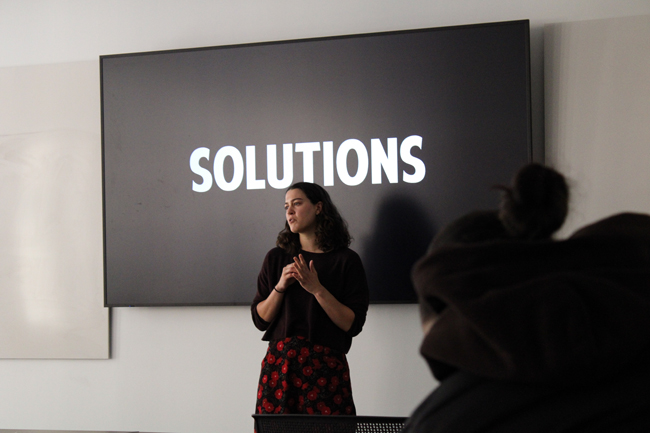
Catherine Prunella talks to FIT students about potential solutions to microfibers entering waterways. Credit: Sumayyah Uddin/NYSG.
Other solutions include the Cora Ball, which can be added to laundry loads to collect microfibers shed during a wash cycle; developing biodegradable textiles; and pursuing policy to regulate microfiber pollution.
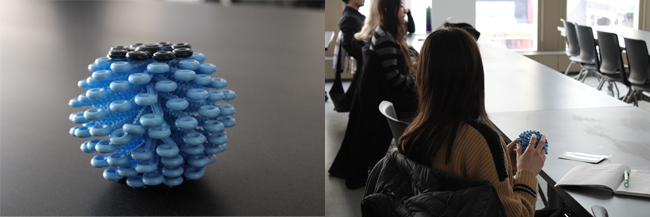
(L) The Cora Ball, a laundry ball designed to collect microfibers during a wash cycle, sits on a table; (R) A student holds the Cora Ball while listening to the presentation. Credit: Sumayyah Uddin/NYSG.
Participants did a number of activities designed to have them think critically about how microfibers actually infuse all parts of our lives, and how certain types of fabrics might be more prone to shedding than others.
“Just because they're ‘sheddy’ does not mean they're bad,” Miller emphasized to the participants. “We’re not vilifying anything in this workshop at all! We're just learning about it.”
Miller brought out a portable microscope and had volunteers come to the front of the room to examine their clothing. Then, participants were given a piece of tape and a white index card. Participants were instructed to stick the tape to their clothes and then to an index card so they could determine whether they had high- or low-shed clothing.
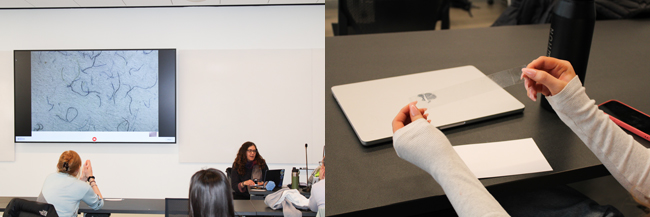
(L to R) Rachael Miller examines microfibers on an index card under the portable microscope; an FIT student shows off their piece of tape with microfibers stuck to it. Credit: Sumayyah Uddin/NYSG.
A final experiment demonstrated how high shed fibers spread with different types of contact. These participants interacted with a high shed shirt (shaking it, rubbing it over clothes, and wearing it over clothes) and then viewed their clothes under a UV light to see how many fibers they’d picked up from the interaction.

(L) A student shakes a high shed shirt while other students look on; (R) Miller uses the UV light on a student who wore the high shed shirt. Credit: Sumayyah Uddin/NYSG.
For more information on work being done in collaboration by NYSG and Columbia University, visit NYSG’s Marine Debris resources page. Visit MyCoast LitterWatch to see more marine debris resources, download the app, and help track litter in your community.
The Rozalia Project is currently accepting applications for volunteer crew this summer. These volunteers will participate in marine debris monitoring and collection aboard the sailboat The American Promise in Maine. Learn more on the Rozalia Project’s website.
More Info: New York Sea Grant
New York Sea Grant (NYSG) is a university-based, statewide Federal-State collaboration between the State University of New York (SUNY), Cornell University, and the National Oceanic and Atmospheric Administration (NOAA). It is one of 34 university-based programs that connects research, extension, and education with the needs of coastal communities, environments, and economies through NOAA.
Since 1971, NYSG has supported science-based solutions for a wide range of water-related challenges and opportunities across the state. Through NYSG’s efforts, university scientists and extension specialists help develop and transfer science and technical information to educational institutions, businesses, agencies, and industries; federal, state and local governments; the media; and the interested public. The program is administratively based at Stony Brook University (SBU) and Cornell's College of Agriculture and Life Sciences (CALS).
NYSG historically leverages on average a 5.5-fold return on each invested federal dollar, annually. The State benefits from this, as these resources are invested in Sea Grant staff and their work in communities right here in New York.
New York Sea Grant, one of the largest of the state Sea Grant programs, maintains Great Lakes offices at Cornell University, SUNY Buffalo, Rochester Institute of Technology, SUNY Oswego, the Wayne County Cooperative Extension office in Newark, and in Watertown. In the State's marine waters, NYSG has offices at Stony Brook University and with Cornell Cooperative Extension of Nassau County on Long Island, in Queens, at Brooklyn College, with Cornell Cooperative Extension in NYC, in Bronx, with Cornell Cooperative Extension of Ulster County in Kingston, and with Cornell Cooperative Extension of Westchester County in Elmsford.
Established in 1966, the National Oceanic and Atmospheric Administration (NOAA)’s National Sea Grant College Program promotes the informed stewardship of coastal resources in 34 joint federal/state university-based programs in every U.S. coastal state (marine and Great Lakes) and Puerto Rico. The Sea Grant model has also inspired similar projects in the Pacific region, Korea and Indonesia.
For updates on Sea Grant activities: www.nyseagrant.org, follow us on social media (Facebook, Twitter/X, Instagram, Bluesky, LinkedIn, and YouTube). NYSG offers a free e-list sign up via www.nyseagrant.org/nycoastlines for its flagship publication, NY Coastlines/Currents, which it publishes quarterly.