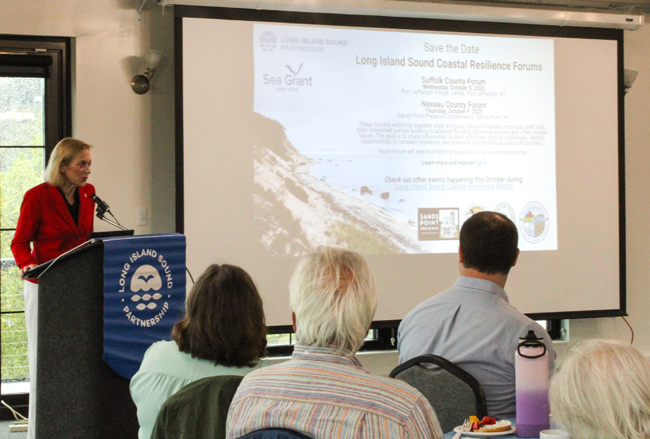
Held in Port Jefferson’s Village Center, the Suffolk County Coastal Resilience Forum opened with a welcome from the Village’s Mayor Lauren Sheprow. Credit: Sumayyah Uddin / NYSG
— By Sumayyah Uddin, NYSG's Science Writer
Contacts:
Elizabeth Hornstein, NYSG Sustainable and Resilient Communities Extension Professional, Suffolk County, E: eeh78@cornell.edu, Phone: (631) 824-4575
Sarah Schaefer-Brown, NYSG Sustainable and Resilient Communities Extension Professional, Nassau County, E: scs292@cornell.edu, Phone: (516) 832-2591
Stony Brook, NY, October 8-9 2025 – October was designated as Long Island Sound Coastal Resilience Month, bringing Long Island Sound communities and partners together throughout the month at various coastal resilience-focused activities and events. To celebrate the month, Long Island Sound (LIS) Partnership and New York Sea Grant (NYSG), in partnership with Suffolk and Nassau County Soil and Water Conservation Districts, hosted consecutive coastal resilience forums and field trips in both Suffolk and Nassau County.
The events, which featured speakers from State and local agencies and organizations, were intended to highlight new and ongoing State-led initiatives, opportunities, and tools. It was a chance to showcase regionally relevant online mappers and resilience resources, paired with the unique opportunity to explore local resilience projects and efforts. These forums brought together 120 regional and local decision makers, non-profits, municipal staff and other interested parties. The goal was to encourage knowledge exchange and further identify opportunities to increase resilience and enhance coordination.
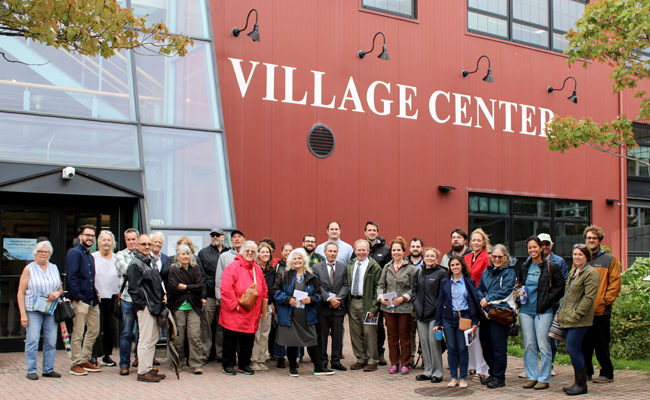
Group photo taken during the Fall 2025 Suffolk County Coastal Resilience Forum in Port Jefferson, NY. Credit: Sumayyah Uddin / NYSG
Suffolk and Nassau County Coastal Resilience Forums
Held in Port Jefferson’s Village Center, the Suffolk County Coastal Resilience Forum opened with a welcome from the Village’s Mayor Lauren Sheprow. The forum focused on providing updates on State resilience initiatives from agencies like the NYS Department of Environmental Conservation and NYS Division of Homeland Security and Emergency Services, as well as presentations on new resilience tools and resources from Seatuck Environmental Association, the U.S. Geological Survey, New York Sea Grant, and Suffolk County Soil and Water Conservation District. The forum was coordinated by Elizabeth Hornstein, a NYSG LIS Partnership Extension Professional in Suffolk County.
State updates included information on the NYS Adaptation and Resilience Plan, the NYS Climate Smart Communities Program, the Long Island Climate Change Adaptation and Resilience Plan Cohort, the NYSDEC Living Shoreline database, and the Suffolk and Nassau Hazard Mitigation Plan and MitigateNY resources — all programs intended to strengthen and support resilience efforts in New York coastal communities. The section on resilience tools and resources highlighted a crossing prioritization tool, an online mapper of compound flood hazards, and resilience resource packets for communities.
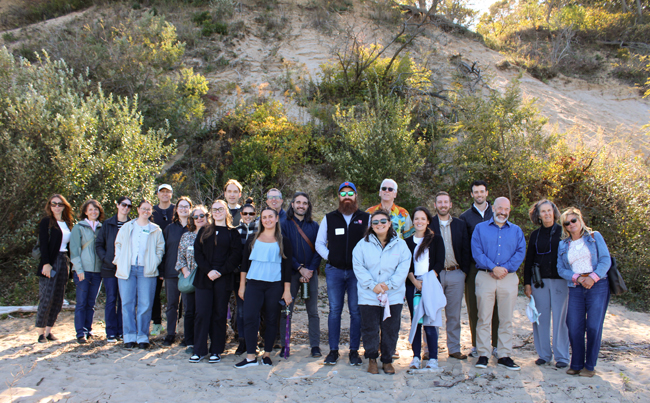
Group photo taken during the Fall 2025 Nassau County Coastal Resilience Forum hosted by Sands Point Preserve Conservancy. Credit: Sumayyah Uddin / NYSG
The following day, forum participants in Nassau County were welcomed to the Great Hall in Castle Gould at the Sands Point Preserve by the Executive Director of Sands Point Preserve Conservancy, Jeremiah Bosgang. Coordinated by the NYSG LIS Partnership Extension Professional of Nassau County, Sarah Schaefer-Brown, the Nassau Coastal Resilience Forum included the same presentations as the Suffolk Forum for a new audience. It also featured region-specific talks from the Nassau County Soil and Water Conservation District and Cornell Cooperative Extension.
Local Resilience Projects Walking Tours
The second half of each forum culminated in a walk focusing on local resilience projects.
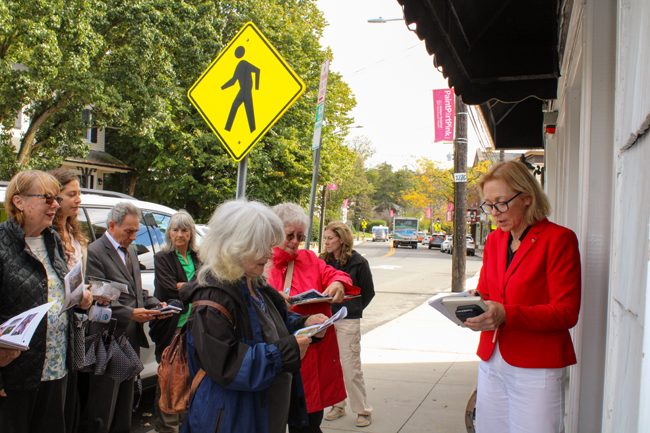
Village of Port Jefferson Mayor Lauren Sheprow leads Coastal Resilience Forum attendees on a walking tour. Credit: Sumayyah Uddin / NYSG
After lunch, Village of Port Jefferson Mayor Lauren Sheprow closed out the Suffolk forum by presenting on the Village’s resilience issues and initiatives before leading a walking tour of the Village. The Mayor provided a “snapshot” of the Village’s history and challenges with flooding and stormwater management, as well as the steps being taken to build a more resilient future. She says the Village is focused on ensuring local voices guide real solutions: “Through newsletters, public updates, and outreach events, the Village continues to make transparency and participation a top priority, because lasting progress depends on an informed, engaged community.”
The tour emphasized the challenges that have been facing residents, while highlighting efforts to mitigate the flooding that jeopardizes and damages property every year.
Along the walk, Mayor Sheprow pointed out the sites of major past flooding events, comparing the flooded pictures on the provided brochures to the relatively calm surroundings. She also introduced attendees to business owners whose businesses, livelihoods, and homes have been severely affected by flooding. The owner of the local restaurant Castaways shared about their flood-proof floor that allows them to quickly re-open after flooding events; their innovative floor is now being used in other Village buildings that are vulnerable to flooding, including the fire house. Attendees then ventured further into the village to visit the beloved Theatre Three.
In the heart of the theater’s speakeasy, which suffers every year from flood damage, Executive Artistic Director Jeffrey Sanzel took a moment to emphasize just how costly flooding is to local businesses.
“It takes about 72 hours of mopping and cleaning to get us back [to where] we can reopen to the public,” Sanzel shared with the group. “As you know, you lose a day, you never get that back. So this [the flooding] is a dire situation.”
The event helped emphasize LIS Partnership's work in coastal resilience in the Suffolk County region.
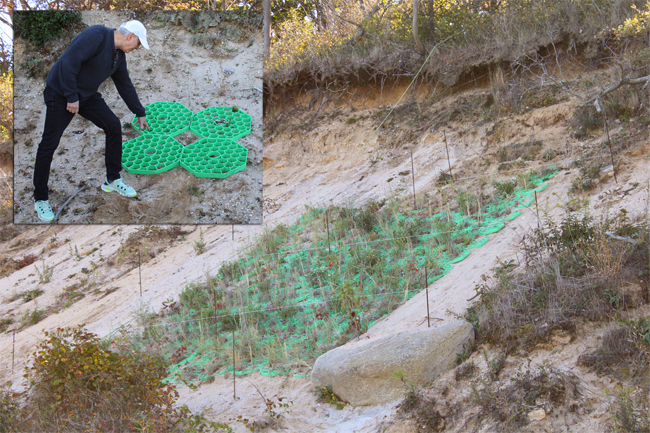
Coastal Technologies demonstrated its cliff stabilizers, which are composed of biodegradable or mycelium plastics to allow the frame structure to fully decompose, during the field trip at the Fall 2025 Long Island Sound Coastal Resilience Forum in Nassau County. Credit: Sumayyah Uddin / NYSG
The Nassau event concluded with a walking tour to the beach, led by Bosgang and Nicholas Thatos from Coastal Technologies Corp.
“The Sands Point Preserve Conservancy was honored to host the Long Island Sound Coastal Resilience Forum for Nassau County,” Bosgang shared. “We are committed to protecting our coastal bluffs and have spent the last several years piloting a new living shoreline restoration project, which we were proud to showcase at the Forum. We are grateful to the Long Island Sound Partnership, New York Sea Grant, and Nassau County Soil and Water Conservation District for their collaboration and trust in our work!”
The tour highlighted the resilience work being done on the bluffs at Sands Point Preserve. The beach was cinematic, with the waves crashing on the shore from Long Island Sound and Hempstead Harbor, a stunning view of the buildings in New Rochelle in the distance, and a beautiful sandy beach climbing up to vegetated bluffs topped by trees – but attendees’ attentions were entirely captivated by the relatively unassuming grid high on the slope of the bluff.
The grid, which looks like a large lattice, is composed of bright-green octagons roughly the size of a stop sign. These Cliff Stabilizers are screwed into the bluff and used to cultivate native plants to reduce erosion caused by wind, rain, and tide. Once the plants have established (usually within two growing seasons) the stabilizers are removed and can be reinstalled again elsewhere. The bright green color of the installed grid was already muted and somewhat camouflaged against the sand by plant-growth – a significant sign of progress.
Coastal Technologies also offers Cliff Stabilizers composed of biodegradable or mycelium plastics, allowing the frame structure to fully decompose.
Conclusion
The Long Island Coastal Resilience Forums emphasized the value of regional collaboration in preparing Long Island communities to prepare for coastal challenges. By bringing together local advocates, leaders, and scientists, LIS Partnership and NYSG created a space to share updates, exchange data, and kickstart valuable connections between attendees.
Coastal Resilience Month events based around Long Island Sound continued throughout October. Connecticut Sea Grant and LIS Partnership, in collaboration with the Avalonia Land Conservancy, hosted a Coastal Resilience Month field trip and workshop on October 16, featuring an up-close look at the Dodge Paddock and Beal Preserve Marsh Restoration Project in Stonington, Connecticut.
To learn more about Long Island Sound Sustainable and Resilient Communities upcoming events, projects, and resources, visit the Long Island Resilience Hub.
More Info: New York Sea Grant
New York Sea Grant (NYSG) is a university-based, statewide Federal-State collaboration between the State University of New York (SUNY), Cornell University, and the National Oceanic and Atmospheric Administration (NOAA). It is one of 34 university-based programs that connects research, extension, and education with the needs of coastal communities, environments, and economies through NOAA.
Since 1971, NYSG has supported science-based solutions for a wide range of water-related challenges and opportunities across the state. Through NYSG’s efforts, university scientists and extension specialists help develop and transfer science and technical information to educational institutions, businesses, agencies, and industries; federal, state and local governments; the media; and the interested public. The program is administratively based at Stony Brook University (SBU) and Cornell's College of Agriculture and Life Sciences (CALS).
NYSG historically leverages on average a 5.5-fold return on each invested federal dollar, annually. The State benefits from this, as these resources are invested in Sea Grant staff and their work in communities right here in New York.
New York Sea Grant, one of the largest of the state Sea Grant programs, maintains Great Lakes offices at Cornell University, SUNY Buffalo, Rochester Institute of Technology, SUNY Oswego, the Wayne County Cooperative Extension office in Newark, and in Watertown. In the State's marine waters, NYSG has offices at Stony Brook University and with Cornell Cooperative Extension of Nassau County on Long Island, in Queens, at Brooklyn College, with Cornell Cooperative Extension in NYC, in Bronx, with Cornell Cooperative Extension of Ulster County in Kingston, and with Cornell Cooperative Extension of Westchester County in Elmsford.
Established in 1966, the National Oceanic and Atmospheric Administration (NOAA)’s National Sea Grant College Program promotes the informed stewardship of coastal resources in 34 joint federal/state university-based programs in every U.S. coastal state (marine and Great Lakes) and Puerto Rico. The Sea Grant model has also inspired similar projects in the Pacific region, Korea and Indonesia.
For updates on Sea Grant activities: www.nyseagrant.org, follow us on social media (Facebook, Twitter/X, Instagram, Bluesky, LinkedIn, and YouTube). NYSG offers a free e-list sign up via www.nyseagrant.org/nycoastlines for its flagship publication, NY Coastlines/Currents, which it publishes quarterly.