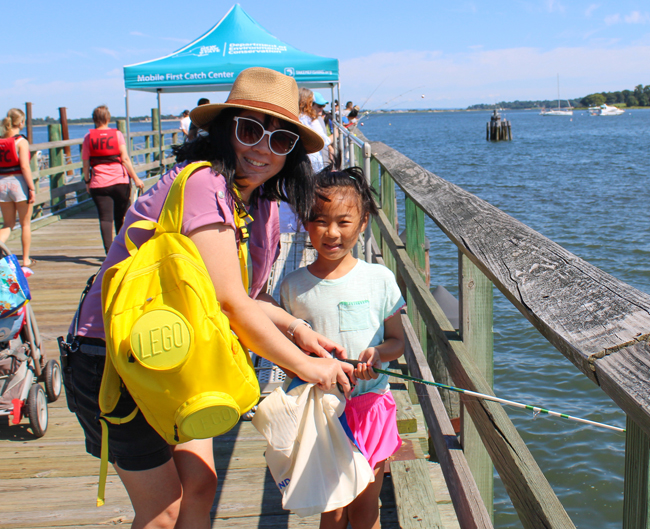
A mother and daughter participate in the fishing clinic at the LIS Exploration Day in Oyster Bay. Credit: Sumayyah Uddin/NYSG
In Long Island Sound Exploration Day’s second year, NYSG and partners engaged attendees in hands-on activities in Oyster Bay (Long Island) and Randall’s Park (NYC).
— By Sumayyah Uddin, NYSG's Science Writer
Contacts:
Jimena Perez-Viscasillas, NYSG Long Island Sound Partnership Outreach Coordinator, E: jbp25@cornell.edu, P: (631) 824-4906
Lillit (Lilli) Genovesi, NYSG Long Island Sound Partnership Outreach Coordinator, NYC, E: Lillit.Genovesi@cornell.edu, P: (718) 874-0120
Stony Brook and New York, NY, September 16, 2026 - The Long Island Sound Partnership (LISP) — a cooperative organization of the U.S. Environmental Protection Agency (EPA), the New York and Connecticut Sea Grant (NYSG, CTSG, respectively) programs, the New York State Department of Environmental Conservation (NYSDEC) and other state agencies and nonprofits focused on restoring and caring for the estuary — hosted the second annual Long Island Sound (LIS) Exploration Day across two locations in the New York Marine District.
Divided into three free community events along Long Island Sound (LIS) on August 14 (Sherwood Island in Connecticut, held by Connecticut Sea Grant and CTDEEP), August 15 (Oyster Bay) and August 22nd (Randall’s Island), the celebrations introduced attendees to activities that deepened their connection with the natural environment of the LIS, from kayaking to fishing clinics to boat rides. Here, in photos, are how the two events went.
August 15th – Oyster Bay, Long Island
LIS Exploration Day in Oyster Bay proved popular with local families. An estimated 400–500 people showed up to the Waterfront Center to peruse stalls from local and federal organizations and non-profits, learn to fish on the dock, go on a kayaking trip, participate in a guided birdwatching tour, seine for marine animals, and more. Along with volunteers and partner organizations, Jimena Perez-Viscasillas (NYSG, Outreach Coordinator for LISP), Sarah Schaefer-Brown (NYSG, Nassau County’s Sustainable and Resilient Communities Specialist), and Elizabeth Hornstein (NYSG, Suffolk County’s Sustainable and Resilient Communities Specialist) were there both coordinating the event and representing New York Sea Grant.
“It was great to see the excitement from kids going from activity to activity collecting their scavenger hunt stamps, and learning about Long Island Sound through different fun games and crafts,” Perez-Viscasillas said. “We really could not have asked for a more beautiful day by the water!”
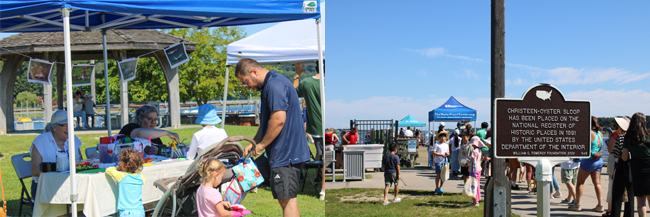
(L) Volunteers help children and families create sock puppets at the craft table; (R) Long lines wait for the chance to sail on the Ida May or sign up for a kayaking trip. Credit: Sumayyah Uddin/NYSG
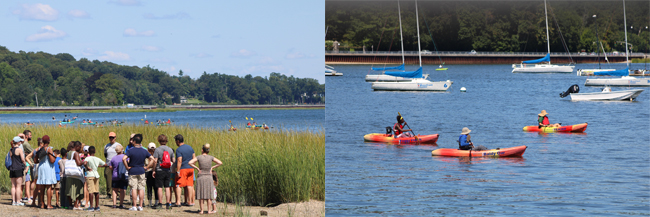
(L) Alexandrea Feit (Audubon New York) leads participants on a bird-watching walking tour while a kayak tour passes in the waters behind them; (R) Lane Smith (NYSG, Research Program Coordinator) co-leads a kayak tour. Credit: Sumayyah Uddin/NYSG
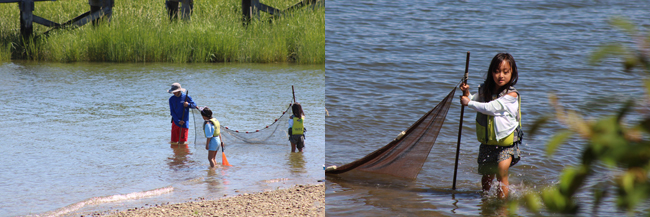
(L) A Waterfront Center staff member helps guide children through a seining activity to catch and observe marine animals; (R) A child carries half of the seining net toward the shore. Credit: Sumayyah Uddin/NYSG
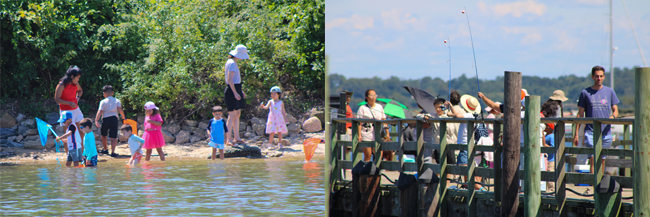
(L) Children use nets to catch marine animals for observation; (R) Children participate in the free fishing clinic led by the NYSDEC off the side of the dock. Credit: Sumayyah Uddin/NYSG
August 22nd – Randall’s Island, NYC
On Randall’s Island, locals turned out for the opportunity to explore the part of Long Island Sound that is practically in their backyard. Hosted by the Long Island Sound Partnership and coordinated through New York Sea Grant, in collaboration with Randall’s Island Park Alliance, NYC Water Taxi, and regional partners, the celebration consisted of a boat tour that traveled from the Ferry Dock toward Throgs Neck and back. Along the way, attendees had the chance to learn more about the wildlife and history of the LIS, participate in a scavenger hunt and trivia, and do hands-on activities that engaged them in all the Long Island Sound has to offer.
Rob Crafa, SUNY Maritime Waterfront Director, was one of the participants who shared information about the LIS on this trip. During one of five slow passes (where the boat briefly slowed down), Crafa spoke about his experience with the gathered group: “I can't recall an event where I learned so much, nor where I received so many questions about Maritime and what we do. The audience was very engaged, not just along for a boat ride. I even connected with an incoming Marine Environmental Science student. [I] look forward to many more great events.”
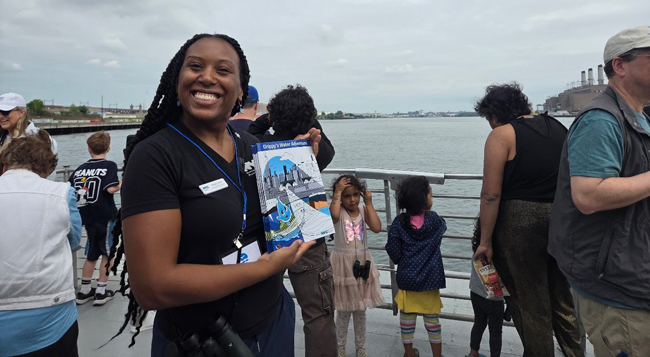
Akilah Lewis, Environmental Educator from NYC Environmental Protection, showcases the Drippy Coloring Book that each of the participating children received. This book features information about NYC’s water story and harbor waters. Credit: Lillit Genovesi/NYSG
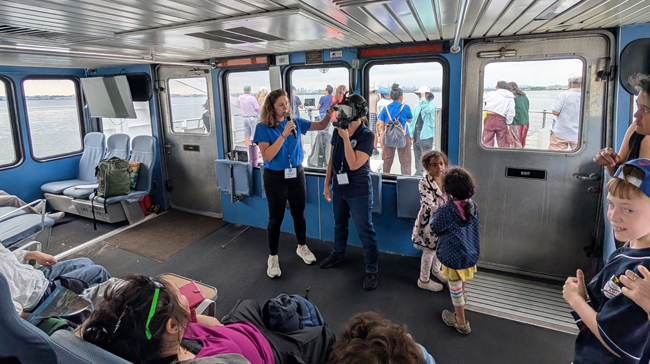
Nikki Tachiki (EPA’s new Director of the Long Island Sound Partnership) and Cayla Sullivan (Habitat and Reporting Coordinator at EPA’s Long Island Sound office) demonstrate dive equipment used to assess and restore LIS estuary habitats. Credit: Lillit Genovesi/NYSG
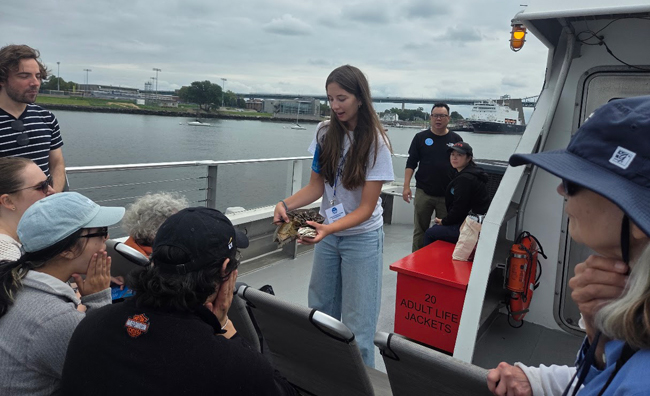
Delaney Briggs (Educational and Outreach Coordinator at City Island Oyster Reef) showcases a horseshoe crab exoskeleton taken from the LIS to participants on the boat tour. Credit: Lillit Genovesi/NYSG
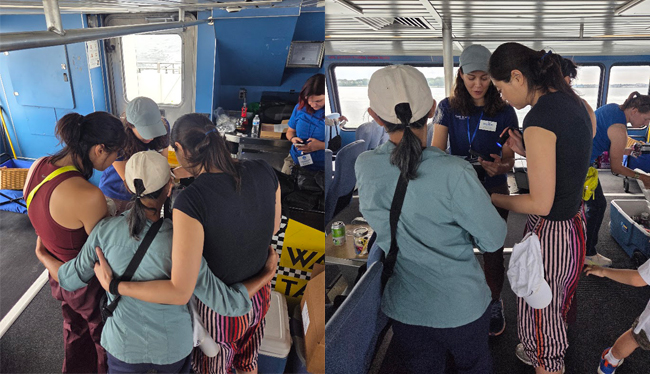
Catherine Prunella (NYSG, Water Quality Extension Specialist) leads a hands-on activity. She presented about water quality, NY MyCoast, and microplastics during the event. Credit: Lillit Genovesi/NYSG
More Info: New York Sea Grant
New York Sea Grant (NYSG) is a university-based, statewide Federal-State collaboration between the State University of New York (SUNY), Cornell University, and the National Oceanic and Atmospheric Administration (NOAA). It is one of 34 university-based programs that connects research, extension, and education with the needs of coastal communities, environments, and economies through NOAA.
Since 1971, NYSG has supported science-based solutions for a wide range of water-related challenges and opportunities across the state. Through NYSG’s efforts, university scientists and extension specialists help develop and transfer science and technical information to educational institutions, businesses, agencies, and industries; federal, state and local governments; the media; and the interested public. The program is administratively based at Stony Brook University (SBU) and Cornell's College of Agriculture and Life Sciences (CALS).
NYSG historically leverages on average a 5.5-fold return on each invested federal dollar, annually. The State benefits from this, as these resources are invested in Sea Grant staff and their work in communities right here in New York.
New York Sea Grant, one of the largest of the state Sea Grant programs, maintains Great Lakes offices at Cornell University, SUNY Buffalo, Rochester Institute of Technology, SUNY Oswego, the Wayne County Cooperative Extension office in Newark, and in Watertown. In the State's marine waters, NYSG has offices at Stony Brook University and with Cornell Cooperative Extension of Nassau County on Long Island, in Queens, at Brooklyn College, with Cornell Cooperative Extension in NYC, in Bronx, with Cornell Cooperative Extension of Ulster County in Kingston, and with Cornell Cooperative Extension of Westchester County in Elmsford.
Established in 1966, the National Oceanic and Atmospheric Administration (NOAA)’s National Sea Grant College Program promotes the informed stewardship of coastal resources in 34 joint federal/state university-based programs in every U.S. coastal state (marine and Great Lakes) and Puerto Rico. The Sea Grant model has also inspired similar projects in the Pacific region, Korea and Indonesia.
For updates on Sea Grant activities: www.nyseagrant.org, follow us on social media (Facebook, Twitter/X, Instagram, Bluesky, LinkedIn, and YouTube). NYSG offers a free e-list sign up via www.nyseagrant.org/nycoastlines for its flagship publication, NY Coastlines/Currents, which it publishes quarterly.